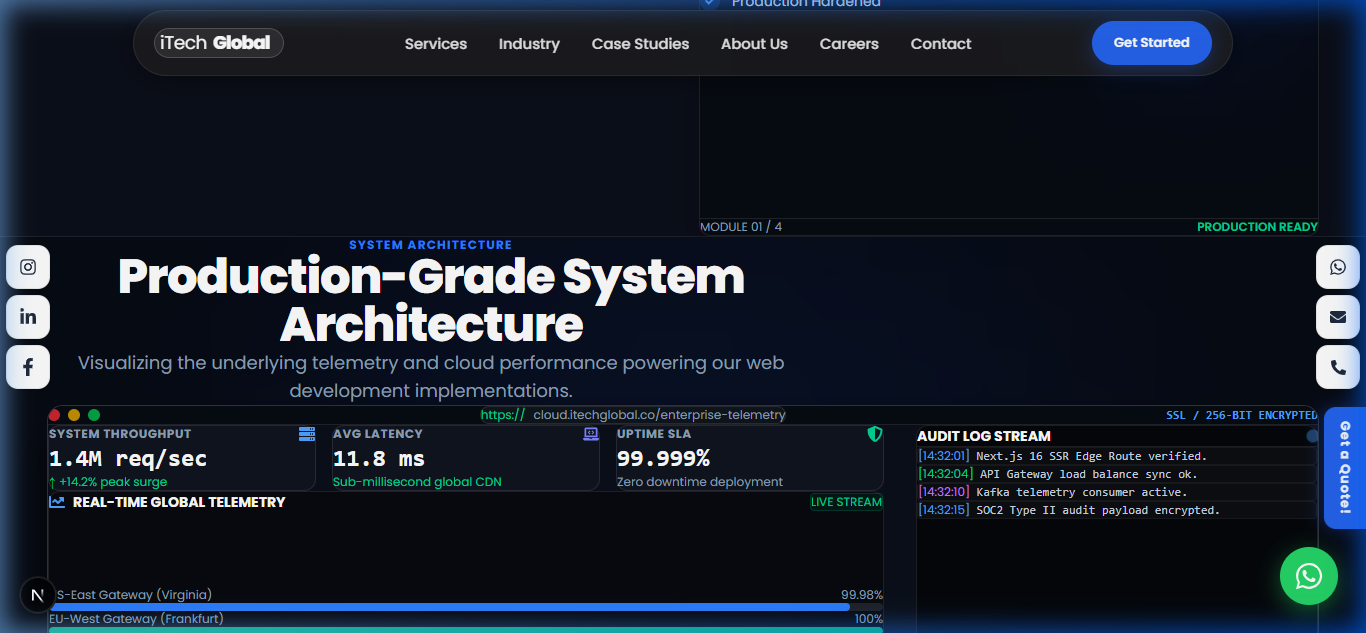
Selecting the architectural foundation for an enterprise web platform is one of the most consequential decisions a chief technology officer or founder will face. Choose incorrectly, and your engineering team spends years wrestling technical debt, painful page loading latencies, and escalating infrastructure expenses.
In modern enterprise web development, agility, sub-second global delivery, and modular scalability are prerequisites for business survival.
The Shift From Monoliths to Modular Edge Architectures
Traditional monolithic web applications often struggle as user concurrency climbs into the hundreds of thousands. Today's leading platforms separate presentation from business logic using headless architectures and edge computing.
Key requirements for high-concurrency enterprise applications include:
- Sub-Second Global Edge Latency: Utilizing Content Delivery Networks (CDNs) and edge functions to process user requests close to their physical location.
- Granular Component-Driven Design Systems: Enabling distributed design and engineering squads to iterate without breaking shared UI elements.
- Automated Security Pipelines: Enforcing strict zero-trust API validation, HTTPS encryption, and granular access controls.
Frameworks Dominating Modern Enterprise Engineering
Different technical frameworks solve distinct operational bottlenecks:
- Next.js & React Server Components: The gold standard for commercial web apps that require high search engine crawlability paired with dynamic authenticated dashboards.
- Headless Micro-Frontend Frameworks: Ideal for large multi-brand conglomerates requiring independent teams to deploy individual modules without central bottlenecks.
- TypeScript End-to-End: Enforces strict type safety across database schemas, API contracts, and user interfaces, reducing runtime bugs by over 40%.
Discover our specialized custom web development services to see how we architect high-throughput applications.
How to Protect Enterprise Platforms Against Obsolescence
To ensure your investment delivers returns for a decade, incorporate four foundational practices:
- API-First Strategy: Build your backend with cleanly documented OpenAPI or GraphQL endpoints so mobile apps and third-party systems plug in effortlessly.
- Strict Core Web Vitals Benchmarking: Maintain Largest Contentful Paint (LCP) under 1.2 seconds across mobile and desktop.
- Automated Regression & CI/CD Pipelines: Prevent accidental downtime with automated unit tests and canary deployments.
Learn how we engineered scalable digital infrastructure for international fintech leaders in our global case studies.
Partner With iTech Global's Enterprise Architects
Whether you are rebuilding an outdated legacy web platform or engineering a groundbreaking cloud product from the ground up, iTech Global delivers precision execution.
Connect with our engineering leadership to discuss your technical architecture.
Frequently Asked Questions
Why is Next.js preferred for enterprise web development?
Next.js offers hybrid static and server rendering (SSR/SSG), automated code splitting, built-in edge caching, and superior Core Web Vitals, making it ideal for search visibility and high-load platforms.
What is the typical development timeline for an enterprise web platform?
A modular enterprise web application typically requires 8 to 16 weeks across discovery, UX architecture, microservices integration, security auditing, and cloud deployment.
How do you ensure data security in custom web builds?
We enforce end-to-end encryption, strict role-based access control (RBAC), OWASP top-10 compliance audits, and regular automated dependency scanning.
Can enterprise platforms connect with legacy ERP or CRM systems?
Yes. Our engineering team constructs RESTful and GraphQL API bridges to integrate seamlessly with Salesforce, SAP, HubSpot, Oracle, or custom proprietary databases.
Ready to Grow Your Digital Presence in Your Market?
Partner with iTech Global's multi-disciplinary engineering and growth team. Get a customized project strategy, realistic timelines, and competitive pricing.